October 31 falls on a Saturday this year. Tashkent venues have already advertised costume parties, while talk of a Halloween ban has followed the holiday for more than a decade. That history includes verbal warnings to venues, restrictions at educational institutions and checks in the street. It also includes years when events reappeared in city listings.
Halloween is celebrated on the eve of All Saints’ Day. Its traditions combine European seasonal customs and the Christian calendar. The modern secular celebration — costumes, pumpkins, scary stories and parties — has spread far beyond the countries where it developed.
When the parties were advertised
By the late 2000s, Halloween was appearing in Tashkent’s club listings. A surviving listing advertises a Tusovka.Uz party at N-Joy on October 31, 2009: DJs, a costume dress code and an age limit of 18. Two years later, CMI openly announced Dark spirit night. The holiday was named directly and guests were invited to dress up.
People were discovering foreign celebrations beyond the clubs too. A substantial feature in Uchitel Uzbekistana, dated February 13, 2004, was devoted to Valentine’s Day. Alongside the story were roses, cards, gifts and festive milkshakes. A newspaper about education was offering readers ideas for presents and holiday drinks.
Criticism appeared alongside those celebrations. In 2006, Fergana reported recommendations that editors avoid mentioning February 14; events were still taking place. The state bibliography for February 2009 records an article in Turkiston titled “February 14 Is Not Lovers’ Day”.
Debate over “our” and “foreign” holidays had begun long before the most visible restrictions.
Public party listings and critical articles coexisted for several years. Practical restrictions later joined the criticism: in the street, at venues and in educational institutions.
How informal restrictions worked
One early episode described in detail took place on October 30, 2011. In a Fergana report published the following winter, a participant in a walk through central Tashkent said they had been taken to a district police department. According to his account, a court later fined him under Article 201, concerning the procedure for assemblies. The young people were walking in costumes and planned to continue the evening at clubs.
By the next Halloween, reports focused on the venues themselves. On November 2, 2012, it was reported that entertainment venue owners had received verbal warnings not to hold celebrations. The outlet’s sources described warnings without a written order being presented — a conversation that could mean cancelling before any guests arrived.
A similar story unfolded around February 14. Reports in January 2012 described the rescheduling of Rayhon’s customary February concert and an evening devoted to Babur at Istiqlol. The poet’s birthday also falls on February 14. Uzbeknavo denied issuing any informal orders and attributed the change to concert preparations. Official explanations and participants’ accounts were already diverging.
Restrictions took a more organised form in educational institutions. In autumn 2013, reports citing district education staff and students described a ministry telephone directive, written undertakings by students and teachers assigned to duty. These were instructions within the education system: heads, teachers and students received their own requirements, including directions not to take part in such celebrations.
When Uz24 asked the Ministry of Culture and Sports about Halloween in 2014, the ministry said that the peoples of multinational Uzbekistan had enough celebrations of their own and that some foreign dates were not observed here.
Restrictions reached people through a club manager, headteacher or lecturer.
Reports from those years used “Halloween ban” for verbal warnings to venues, internal instructions and street checks.
How practice began to change
A report from 2016 shows the differences between venues. Some cafés and restaurants were holding Halloween events and tailoring shops were receiving costume orders. Other venues in the same report described continuing warnings and declined to celebrate. Even on the same evening, there was no single approach across the city.
In November 2017, the police publicly stated their position. Tashkent’s police department denied reports of instructions to ban the holiday and close cafés, bars and restaurants, attributing increased security to maintaining public order. Some police representatives nevertheless continued to criticise the holiday and its compatibility with local traditions.
In 2018, the department again said that it was not planning special measures restricting Halloween. Participants were reminded that general legal requirements applied.
By the 2020s, public announcements were again part of the city’s calendar, with a much wider range of formats.
Vampires, Wednesday and Halloween
In 2026, venues use different names for the celebration. SALAMA directly advertises a Halloween party; UNITY offers a carnival with a costume contest. SALAMA specifies a Horror dress code; UNITY lists a minimum age of 18, a deposit and a costume contest.
American Corner Tashkent has also named its programme Halloween Party. There are costumes, games and an introduction to American traditions. Community gatherings and cultural programmes have joined the club nights.
Some venues choose a more specific theme. A recent HD Magazine guide includes a Vampire Diaries evening, Wednesday, Hotel Transylvania, a vampire ball and pumpkin activities. A familiar film or series gives guests a visual starting point: dark clothes and vampire imagery for some, a family programme with familiar characters for others.
Venues still set their own rules. Before buying a ticket, it helps to ask whether a costume is required, whether masks are allowed inside and whether there is an age limit.
The journey there falls under the general rules for streets and transport — which brings us to covering your face.
Can you go out in face paint?
Halloween can be celebrated at home or at a costume event held by a venue. In the street, however, the rule concerns whether a person can be identified: since 2023, Article 184-4 of the Code of Administrative Liability has applied to being in a public place with the face covered to an extent that prevents identification. That is the relevant test for face paint too.
The fine is 10–15 basic calculation units (BRV). With the basic calculation unit set at 440,000 sum from September 1, 2026, the fine currently comes to 4.4–6.6 million sum.
The law provides exceptions for medical indications, protective traffic helmets, work and service, and participants in sporting and cultural events while those events are taking place.
Those last words matter: the journey to a party by metro or on foot is not expressly included in that exception.
One practical example occurred on October 31, 2024. After a video of people wearing face paint appeared, the police said that two adults had been taken to an internal affairs department for identification. The department cited their behaviour and painted faces as the reasons for the check; they were released after being identified.
For the journey, an outfit that leaves your face open and recognisable is more convenient; a full mask can stay in your bag until you reach the venue. Its use inside should be discussed with the organiser in light of the event’s status. If your look relies on pieces that cover your features, put the costume together so they can be removed before going outside.
An identity document is useful too. It helps establish who you are, although the officer must still explain the grounds for the check.
If you are stopped or taken to a department
Under the law, an internal affairs officer approaching a person must state their position, rank and surname, show official identification on request, and explain the reason and purpose of the approach. If a person’s rights are restricted, the officer must explain the grounds, rights and obligations.
You can therefore start with two straightforward questions: who is speaking to you, and why? Keep the conversation calm.
A separate procedure governs patrol officers’ use of E-patrul. It sets grounds for a stop: suspicion of an offence or that the person is wanted, information suggesting the person knows about an offence, or another lawful ground for detention. The reason for identification must be given.
If you have no identity document with you, you may be taken to a department when, for example, identification through the tablet has failed.
If you are asked to go to a department, ask which procedure is being used: bringing you in, administrative detention or another action. Administrative detention requires a record stating its grounds, place and time. The general rule is up to three hours from being brought in for the report to be drawn up. If a person withholds information about their identity, detention may last up to 24 hours.
If detained, you can ask for a relative and a lawyer to be notified. You have the right to see case materials, give explanations, use your native language and have an interpreter. Your account and comments can be entered in the administrative-offence report.
If you consider an officer’s actions unlawful, a complaint can be made to their superior, a prosecutor or a court. The Interior Ministry has a number for complaints about unlawful staff actions: 1102.
Useful details include the date, place, officer’s details, time you were brought in and what happened. Keep them while the sequence is still easy to reconstruct.
Your own Saturday at home
Halloween works well at home too: a small group, a familiar kitchen and a choice of just how scary the evening should be. This year it falls on Saturday, so the evening can unfold without a rush.
Here are a few ideas that do not need a separate decorating budget.
Try a film dinner with a short trailer of your own. Each person brings one item for a costume — a cape, hat, glasses or an odd jumper. While the food cooks, shoot a minute-long “horror film” on a phone: a creaking door, missing samsa, a highly suspicious cat.
Then watch the film you chose together and premiere your own footage. Special effects depend entirely on a table lamp and how seriously the actors take their roles.
Another option is an evening of short stories. Allow up to five minutes each: a story from a book, an urban legend or something invented. Anyone who does not want to perform can bring a note for someone else to read. After each story, listeners guess where it came from.
You can exchange sweets within the group or arrange it with neighbours in advance.
Have a good Halloween!
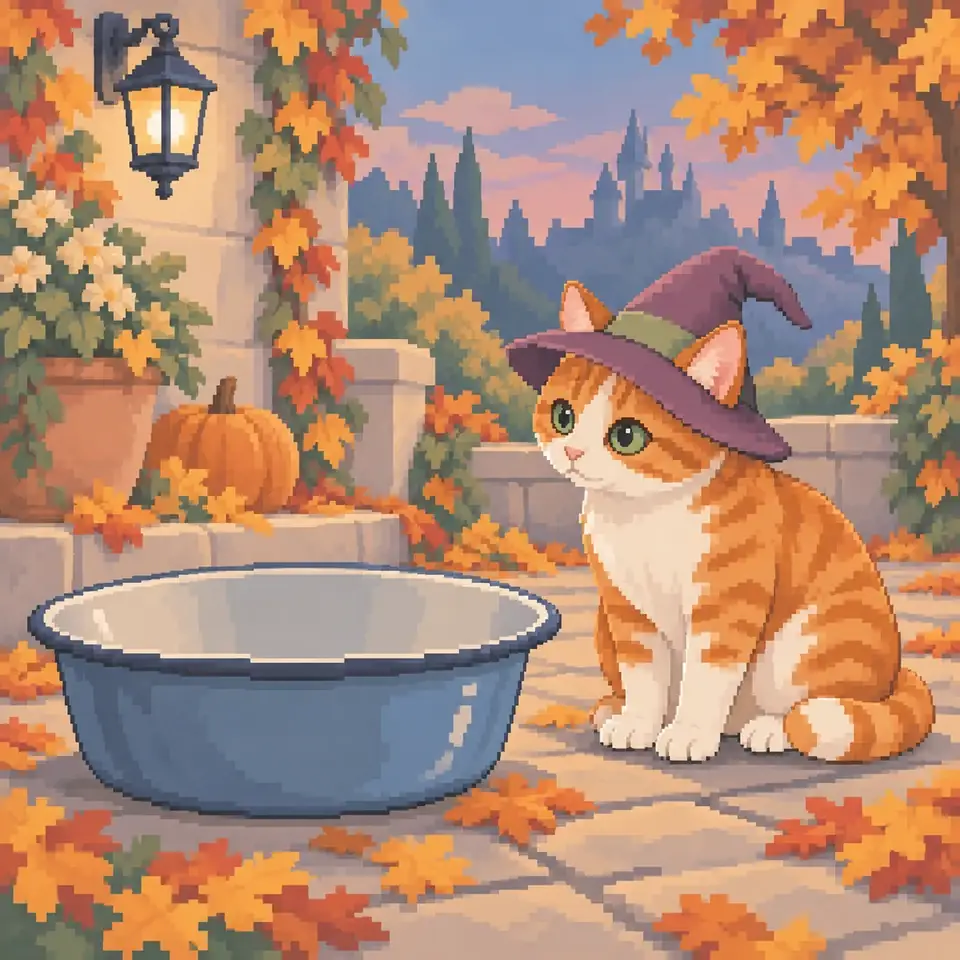
Some will choose a party; others, a film and pumpkin samsa. If you remember Tashkent Halloweens from earlier years, tell us in the comments what they were like for you.
Claim the usual tazik for reading the article, and send the article to the person you plan to celebrate with 🧡
And take a look around the new version of the app: until the end of November 5, 2026, Tashkent time, there are nine candies to find. Collect them in any order.
Once you find all nine, you will receive the legendary Spooky Basin and the Scary background, and can choose one item for your cat: Ghost, Pumpkin or Witch Hat. You get one choice, and it cannot be changed later.