
If you’ve been wishing for a tree outside your window, autumn is a good time to get started. Ask a few neighbours to share the cost and care, then look for a spot together. Buy the sapling once you’ve agreed where it will go and how you’ll water it.
Talk to your neighbours first
Start with your building’s residents’ council, homeowners’ association or management company. Ask to see the boundaries of the land attached to the building and find out how to get approval for planting. Under Uzbekistan’s law on apartment building management, this land is granted to the property owners for permanent use, and they are responsible for looking after it.
For a spot outside those boundaries, contact the mahalla office or district landscaping service. They can help you establish who is responsible for the land. An empty patch beside a road or canal still needs checking before anyone starts digging.
Mark the proposed spot on a photo of the courtyard and show your neighbours. Will the tree block someone’s window or get in the way? Who will buy it, and where will the water come from? If you’re using shared funds, ask the management company how the decision needs to be recorded.
Check below ground — and look up
Ask the management company for a plan of underground pipes and cables. Have someone who maintains the building’s utilities check your chosen spot. Manhole covers and the appearance of the lawn won’t tell you reliably what runs underneath. Wait until you know where the services are before digging.
Look around for overhead wires, balconies, paths and parking spaces. Keep building entrances, fire access routes and manholes clear. There needs to be room for the tree in ten years’ time, as its branches and roots spread.

Tell the nursery about your courtyard
Take photos of the spot. Explain how much sun it gets, what the soil is like and how often you’ll be able to water. Uzbekistan’s Forestry Agency also advises choosing trees for the climate, soil and available water. Ask for a suitable tree and check its mature height and spread.
Get the exact species and variety name. Trees sold under the same familiar name can grow to very different sizes. How far to plant from buildings, paths and other trees will depend on the species and the location of underground services.
Inspect the sapling with the seller. Look for healthy bark and live roots that haven’t dried out. Roots tightly circling the pot, wire cutting into the trunk or damage the seller can’t explain are reasons to choose another plant.
A fruit tree could work, too. Agree on who will pick the fruit and clear up anything that falls, especially near a path or parked cars.
Wait for cooler weather
Bare-root deciduous trees are best planted while dormant, after their leaves have fallen. The ground should be unfrozen and free of waterlogging. Container-grown trees give you more flexibility, though planting after the heat has eased makes the job easier. Check the timing for your chosen species with a local nursery.
Buy close to planting day. If plans change, keep the sapling in shade and make sure its roots stay moist. Cover bare roots with damp material: sun and wind can dry them out quickly.
Plant the tree
Have water, a spade and mulch ready. Wood chips or shredded bark will do for the mulch. Then work through these steps.
- Water a container-grown tree first. Carefully remove the pot. If the root ball comes wrapped in another material, ask the nursery which wrapping to remove before planting.
- Find where the trunk meets the roots. The trunk widens at its base, where the first large roots emerge. Sometimes excess nursery soil covers this point; gently remove it.
- Dig a wide hole. Give the roots plenty of room. Set the depth so that the point where those first roots emerge sits at the surrounding soil level. Don’t bury the trunk.
- Stand the tree upright and refill the hole. Use the soil you dug out. There’s no need to add manure or concentrated fertiliser to the planting hole. Firm the soil gently by hand.
- Water slowly. Let the water soak through to the roots. Check for settling: if the base of the trunk has sunk below soil level, adjust the tree straight away.
- Spread mulch over the soil. Aim for a layer about 5–7 cm deep, leaving roughly 10 cm of clear soil around the trunk. Keep mulch away from the bark.
The Royal Horticultural Society’s planting guide explains these techniques in more detail. Your nursery can advise on anything specific to the tree you’ve chosen.

Add support if the root ball moves
A small, stable tree in a sheltered spot may not need staking. If the wind rocks the whole root ball, place stakes outside it and secure the trunk with wide, soft tree ties. Leave a little room for the trunk to move.
Check the ties regularly, particularly as the trunk thickens, and loosen any that start pressing into the bark. Remove the support once the tree is rooted firmly enough to stand on its own. Don’t wrap wire around the trunk.
If cars park nearby, mark the planting with a low guard. Keep it clear of the tree and leave access for watering. Let whoever cuts the courtyard grass know, too: a strimmer can easily damage young bark.
Set up a watering rota before summer
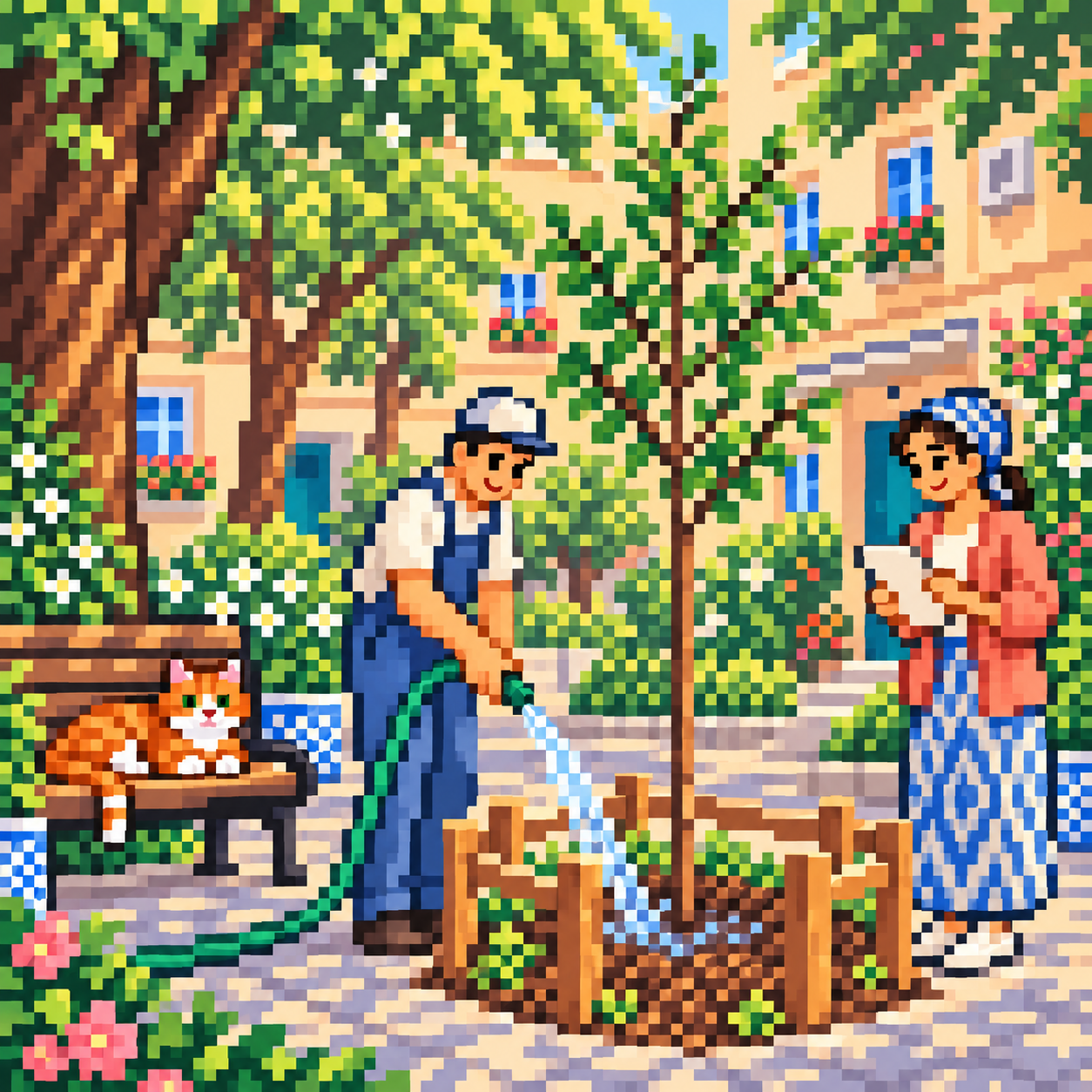
A young tree needs regular attention through a Tashkent summer. In spring, check in with the neighbours who offered to help. Write down names, watering days and a contact for holiday cover. Plan to share the care in the following seasons as well, while the tree establishes.
Check moisture within the root ball. A dry surface doesn’t necessarily mean the roots need water. Water slowly and give it time to soak in. The amount and frequency depend on the weather, soil and size of the tree; a fixed number of buckets won’t suit every courtyard.
If water stays pooled around the tree, find out why it isn’t draining before adding more. After strong winds, check that the sapling is still firm. Look over the ties and bark, and move any mulch that has blown away or been piled against the trunk.
Ready to plant?
Tick off what you’ve done — your list stays on this device
0 of 6 done
Share this guide in your building’s group chat when you’re ready to plan the planting 🧡